Monday, May 29, 2023

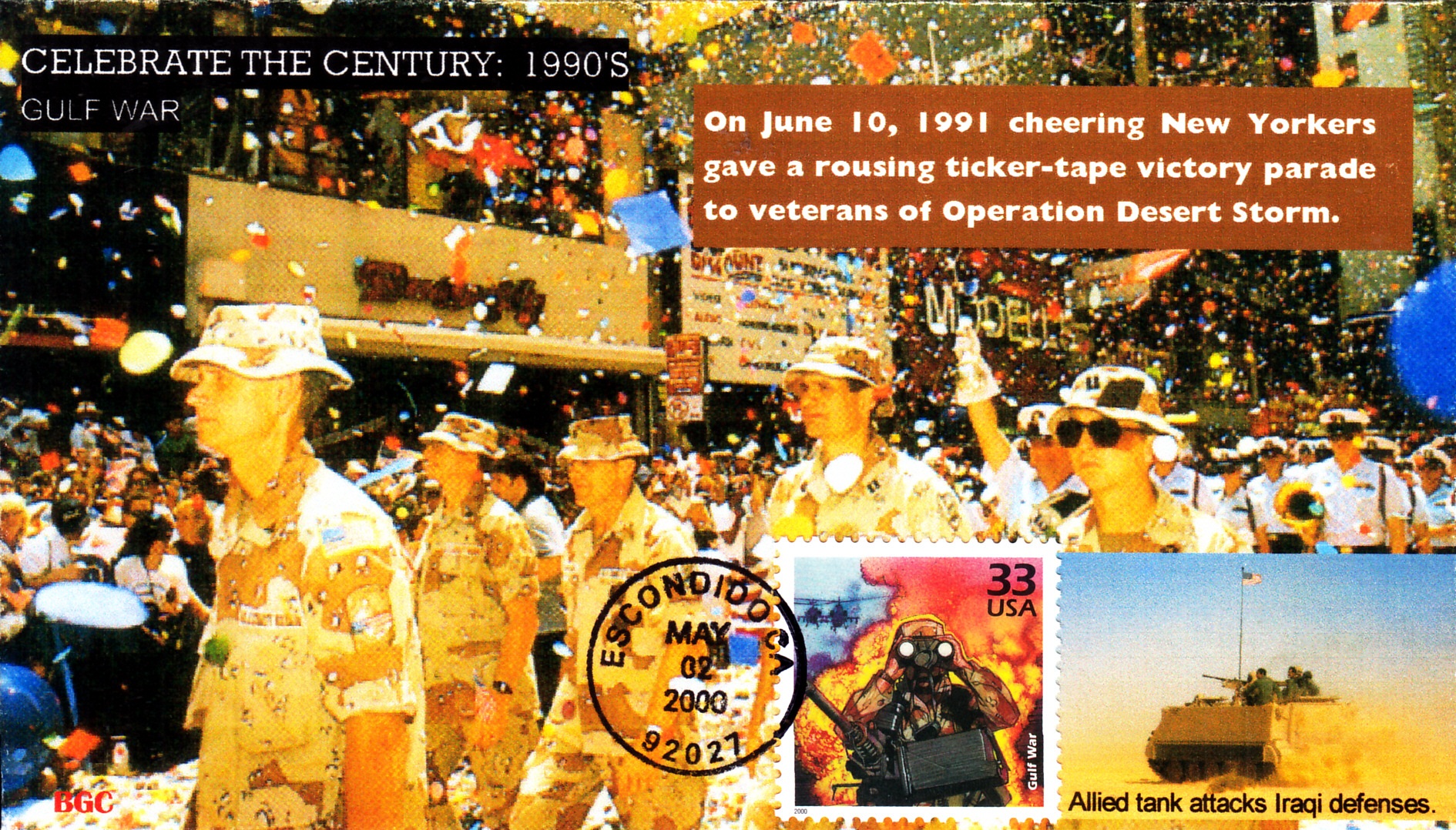
USPS Persian Gulf War


USPS on 2 May 2000 issued a 33 cent stamp commemorating the Persian Gulf War. It was one of 15 stamps included in the 1990s series called "Celebrate the Century". This multicoloured stamp was printed by Ashton-Potter (USA) Ltd, using a lithograph method. It featured 11 ½ perforations. A total of 8,250,000 stamps were printed. First Day Cover originated from Monterey, CA. This cover of returning US forces to a ticker-tap victory parade in New York, however, is postmarked Escondido, California on 2 May 2000.

The Persian Gulf War was the first major international encounter since the end of the Cold War. The war was fought between Iraq and a coalition of 39 countries, organised mainly by the United States and the United Nations.

The war took place in Iraq and the small, oil-rich nation of Kuwait.  Western governments believed Iraq was prepared to invade Saudi Arabia next, and that the world’s supply of petroleum was in jeopardy. The coalition placed embargoes on Iraq, but they refused to retreat. On 17 January 1991, the bombing of Iraqi military and industrial targets began. A massive ground attack was launched in February, and the Iraqis were quickly defeated and driven out of Kuwait. 

Immense human suffering in the Middle East occurred as a result of the Gulf War. Environmental damage occurred when the Iraqis set hundreds of Kuwaiti oil wells on fire and dumped huge amounts of oil into the Persian Gulf. Baghdad was hit by some of the most devastating air raids in history, knocking out communication and public works systems.


USPS "Black Heritage" - Malcolm X


USPS on 20 January 1999 issued a series of "Black Heritage" stamps, including one that honoured Malcolm X. First Day Cover stamps were pos, using the  lithograph printing method. This multicoloured 33 cent featured a serpentine die cut with 11.4 perforations and postmarked New York, NY. Banknote Corp. of America printed 100,000,000 copies.

In 1952, Malcolm X became a leading spokesman for the Nation of Islam. He  delivered stirring speeches and encouraged followers to demand peace by any means necessary, including violence and militant protests.In 1963, Malcolm and Elijah Muhammad began disagreeing, and Malcolm X was suspended from the movement. He traveled to Mecca, Saudi Arabia, Islam’s holy city. There he learned that orthodox Muslims preach equality. After the pilgrimage, he adopted the name El-Hajj Malik El-Shabazz and embraced the idea that equal rights could be attained peacefully.

To this end, Malcolm started the Organization of Afro-American Unity in 1964. However, tragedy struck before he could firmly establish the group. On February 21, 1965, Malcolm was slated to speak at the Audubon Ballroom in Manhattan. As he was speaking, three men rushed the stage and shot him multiple times at close range. He died before reaching the hospital at age 39.

The three men (two radicals in the Nation of Islam), were given life in prison for the murder. Although Malcolm X is often remembered for his pro-violence stance, his highly acclaimed posthumous autobiography (The Autobiography of Malcolm X: As Told to Alex Haley) shed new light on his spiritual journey.

Source: Mystic Stamps

Wednesday, May 24, 2023

Malaya Definitives with QueenElizabeth II - 1957

MALAYA on 15 March 1957 issued a set of 11 stamps related to industries and culture of Tanah Melaya. Each state released the same stamps, only difference being a cypher representing the head of each state, i.e. Sultans of Johor, Kedah (shown in cover), Kelantan (shown in cover), Pahang, Perak, Perlis, Selangor and Terengganu (shown in cover). The States of Malacca  Negeri Sembilan,  Penang, and Singapore featured Queen Elizabeth II (shown individually and on cover); after Merdeka her cypher was replaced with the respective State crests. Perforations for these stamps were 13 x 12½.
 
 The stamps in this series included:
  1c - Black - Copra
  2c - Orange - Pineapples
  4c - Brown - Rice Field
  5c - Red - Mosque
  8c - Green - East Coast Train
10c - Brown - Malayan Tiger
20c - Light Blue - Fishing
50c - Dark Blue - Aborigines with Blowpipe
  $1 - Purple/Blue - State Secretariat Office
  $2 - Red/Green - Bersilat
  $5 - Green/Brown - Weaving

The cover shown here originated from Johor Bahru, Johor and is dated 1960 -- three years after these stamps were initially issued.

Friday, May 19, 2023

Sarawak Sir Charles Vyner Brooke with British Crown Overprint

SARAWAK Sir Charles Vyner Brooke, the third and last white Rajah of Sarawak, was ruler of this north Borneo State until it became a British colony. These stamps wer part of a series iitially issued in the 1920s. After WWII, when Sarawak became a Crown Colony the stamps featured a 'crown' overprint.

In 1841, Sarawak proved to subject to piracy and lawlessness until British adventurer James Brooke helped to subdue the rebellion, for which he was given Sarawak to govern. The Brooke dynasty lasted until Sarawak became a British colony in 1946, gained independence in July 1963 and joined the Federation of Malaysia in that September.

Wednesday, May 17, 2023

North Borneo Definitives with Queen Elizabeth II - 1954 till 1957

NORTH BORNEO in 1954 issued the unpopular definitives from the reign of George VI, which were adapted for the reign of Queen Elizabeth II. These were placed on sale intermittently from 1954 to 1957 as required. Although widely sold in collectors’ packets, there was little postal demand for the 1c. until 1959, when it became a useful ‘make up’ stamp for revised charges.

-   1c - Mount Kinabalu
-   2c - Murut with Blowpipe
-   3c - Coconut Grove
-   4c - Hemp Drying
-   5c - Cattle at Kota Belud
-   8c - Map of North Borneo
- 10c - Timber Logging
- 15c - Native Prahu at Sandakan
- 20c - Bajau Chief
- 30c - Suluk Craft Lahad Datu
- 50c - Clock Tower Jesselton 
-   $1 - Bajau Horsemen


North Borneo Pictorial Stamps with Queen Elizabeth II - 1961

NORTH BORNEO in 1961 issued a series of 16 'pictorial' stamps with the Queen Elizabeth II cypher The pictorials ranged from 1c. to $10 continued with topics reflecting previous definitives. Waterlow was the printer until 1962, when production was  taken over by De La Rue after purchasing Waterlow’s banknote and stamp printing business.

Stamps shown here include;
-   1c - Payau
-   4c - Honey Bear
-   5c - Clouded Leopard
-   6c - Dusun Woman with Gong
- 10c - North Borneo Map
- 12c - Tembadau
- 20c - Phalaenopsis Orchid
- 25c - Rhinoceros
- 30c - Murut with Blowpipe
- 35c - Mount Kinabalu
- 50c - Dusun and Buffalo Transport


North Borneo 75th Anniversary of the British North Borneo Company - 1956

NORTH BORNEO issued in 1956 a special set of  stamps to commemorate the 75th anniversary of the British North Borneo Company. This series was marked in denominations of 10c., 15c., 35c. and $1. It bore the Queen Elizabeth II cypher  and featured designs reminiscent of earlier Waterlow printings.

- 10c - Borneo Railway 1902
- 15c - Native Prahu
- 35c - Mount Kinabalu
-   $1 - Arms of Chartered Company


Friday, May 12, 2023

United States Post Office "Overrun Countries" - 1943-1944

UNITED STATES POST OFFICE between 1943 to 1944 issued  13 stamps known as  "The Overrun Countries" series, which paid  tribute to the countries overrun and occupied by the Axis powers during World War II.

The countries honoured were Poland, Czechoslovakia, Norway, Luxembourg, Netherlands, Belgium, France, Greece, Yugoslavia, Albania, Austria, Denmark, and Korea. The stamps were issued in that sequence at various dates in 1943, except the Korea stamp, which was issued 2 November 1944.

All of these stamps were 5-cent in denomination, 84/100 by 1 44/100 inches in dimension, arranged horizontally, and issued in sheets of 50 stamps each.

The central subjects, which were surface printed, reproduced in natural colours the flags of the respective countries with the name of the country underneath. Rays of light extended from behind the central subjects to the outer frames. The main frames of the stamps, steel engraved, were printed in purple and depicted on the left the phoenix, a mythological bird symbolising the renewal of life, and on the right, in a corresponding position, a kneeling female figure portraying the breaking of the shackles of oppression and enforced servitude. Both figures were supported by pedestals on which, in oval-shaped panels with dark ground, the numeral 5 is indicated in white. These pedestals rest on a panel, in which appeared the word "Cents" in white-faced Roman. Immediately back of the wording the panel was of a darker shade fading out at each end. Across the top of the stamps were the words "United States Postage" in white-faced Gothic, within a ruled panel with ornamental scroll ends.

The concept for the stamps was mooted by President Franklin Roosevelt, an avid stamp collector himself.

The Bureau of Engraving and Printing, Treasury Department, contracted with the American Bank Note Co., New York, N.Y., for printing of these stamps to take advantage of their special multicolour printing equipment.


Labuan Overprints - 1900 till 1906

LABUAN overprint on State of Borneo stamps went into effect from 1900 till 1906 when it came under administeration of the British North Borneo Company.

The stamps shown here include:
8c - Red/Black - Tongkang - Labuan Postage Due 1901  State of North Borneo
10c - Blue/red - Crown Colony - Labuan 1902 Labuan Colony
10c - Crown Colony

Labuan is a small island about the size of Miami off the coast of North Borneo. Uninhabited when the Portuguese discovered it in 1497, its harbor served as a safe anchorage for ships waiting to enter port of Brunei back when the region was a haven for pirates.

James Brooke, “the white Rajah of Sarawak,” aggressively expanded British control over the Sultan of Brunei’s lands on the northern coast of Borneo. He and the British Navy decided Labuan would be a valuable coaling station as well as a base for fighting piracy. In October 1844, when they sailed into Brunei harbor to ask the sultan to give Labuan to Queen Victoria, the Sultan reluctantly agreed. The fact that a British warship near the Sultan’s palace lined up with cannons ready to fire enhanced the persuasiveness of their proposal.

Labuan became a Crown Colony in 1848, hoping it might one day rival Singapore as a trading centre, but these hopes did not bear fruit. The colony survived on grants in aid until 1869, going deeper into debt each year, until administration was transferred to the British North Borneo Company on 1 January 1890. That did not work out well either, and on 1 January 1906, Straits Settlements assumed responsibility for the colony, incorporating Labuan entirely two years later.


Source: American Philatelic Society

Thursday, May 11, 2023

Postes France Tri-Color Legion Waffen SS Strip

POSTES FRANCE issued on 12 October 1942 a strip with three stamps (blue, white and red), hence 'Tri-colour Legion'. These stamps were printed to raise money for the Waffen SS, Tricolor Legion. The legion was comprised of volunteers who fought with the German Army on the eastern front against the USSR. The stamps depicted the Legionnaire and Napoleonic infantry charge.

Period of validity:  until 25 May 1943
Size of each stamp: 40 x 26 mm
Designer: Pierre Gandon
Emission: Semi-Postal
Perforation: 13
Printing: Recess
Print run: 2,416,000

 Source: www.allstamp.net

Postes France French Tricolor Legion Bolshevism (LVF) Propaganda Stamps

POSTES FRANCE in 30 April 1942 printed five propaganda stamps to raise money for members of the French Tricolor Legion Bolshevism - LVF (Légion des Volontaires Français contre le Bolchévisme).  The stamps were printed and sold by the 'Action Committee of the French Legionnaires to combat Bolshevism.' The stamps depicted the military forces of the LFV. A million stamps were printed, but approximately only 450,000 were sold. There were 24 different sectors where the Legion was stationed, all having their own postal sector number.

The Legion of French Volunteers Against Bolshevism was a collaborationist French militia founded on 8 July 1941.  Parti Populaire Francais (French Popular Party, the most active of all the French fascists organizations) launched the idea of a Legion of French volunteers to help fight the Red Army. Eventually all the leaders of the French fascist and collaborationist groups, led by Doriot, Deat, Bucard, Costantini, Deloncle, Boissel, Clementi, met at Wehrmacht headquarters in Paris where the Central Committee of the LVF was created. Recruitment was limited to the occupied zone, number of recruits limited to 15,000 (a figure never achieved).

General Philippe Pétain, head of state of Vichy France, personally disapproved of Frenchmen wearing German uniforms, but never went beyond individual and informal words of support to some specific officers. The Legion of French Volunteers Against Bolshevism volunteered to fight against the USSR on the Eastern Front. It was officially known to the Germans as Infantry Regiment (Infanteriereregiment) 638 LVF (Französischer Infantry-Regiment 638 LVF). The LVF were generally poorly trained, equipped and led, eventually suffering huge losses. By mid-1944 the remaining LVF was incorporated into the French Waffen SS.


Source: www.axishistory.com and www.allstamp.net

Friday, May 5, 2023

1st Anniversary of Malaya Independence at Stadium Merdeka - 1958

PERSKUTUAN TANAH MELAYU on 31 August 1958 issued a stamp marking the 1st anniversary of Malaya Independence at Stadium Merdeka, where the Independence Declaration was held on 31st August 1957.

The FDC cachet is one that was available at any post office in the Federation of Malaya What makes this FDC special is the location stated on the postmark cancellation -- Singapore. One has to remember that Singapore was once part of the Federation of Malaya up until 1965.

Formation of Malaysia - 1963

PERSKUTUAN TANAH MELAYU on 16 September 1963 issued three commemorative stamps marking the Formation of Malaysia, particularly the incorporation of Sarawak and Sabah (East Malaysia) with peninsular (West Malaysia). A map showing both West and East Malaysia was highlighted in yellow.  The nation's 15-point star radiated over the map. The denominations ranged from 10c (brown), 12c (green) to 50c (blue).

The original date for the formation of Malaysia was initially set for 1 June 1963. This date was postponed until 31 August 1963 in order to align with Merdeka Day. However, due to objections from  neighbouring countries (namely Indonesia with support from China, USSR and Philippines and various political parties in Sabah and Sarawak), the date was rescheduled to 16 September 1963.

Interestingly, this postal cachet with the national flag included the 1963 Merdeka slogan “Berjaya Malaysia” which would have been applicable for the original print date of 31 August 1963. Additionally, the cancellation postmark for this FDC originated from Singapore, which at the time was part of Malaysia and remained so up until 1965. This FDC was posted to New Zealand in 1963, which I purchased from a philatelist there; so, finally after 60 years, it has now returned home to Malaysia.