Sunday, October 22, 2023

Pakistan Post 70th Anniversary of Diplomatic Relations between Pakistan and Spain

PAKISTAN POST on 14 January 2022 issued two First Day Cover Stamps to mark the 70th Anniversary of Diplomatic Relations between Pakistan and Spain. The stamps feature two buildings: Islamia College Peshawar and Plaza de Cilebes Madrid. These multicoloured stamps,  valued at Rs.20.00  each, were printed using an Offset Lithographic method.

The designer was Mughiz Khan. The printer was National Security Printing Company in Karachi. A total of 400,000 stamps were printed. Shown here are two maxim cards, each featuring  the respective stamp with national landmark set against the facades of the Badshahi (Pakistan)  and Cordoba Mosque (Spain).  

Pos Malaysia 50 Tahun Bandar Raya Pertama Kuala Lumpur - 2022


POS MALAYSIA on 7 July 2022 issued a single First Day Cover marking "50 Tahun Bandar Raya Pertama Kuala Lumpur (or 50 Years of Malaysia’s First City– Kuala Lumpur)". It was launched in conjunction with the Golden Jubilee celebration organised by Kuala Lumpur City Hall to commemorate the 50th anniversary of the declaration of Kuala Lumpur as the first city in Malaysia in 1972. Special postmark of the KL skyline originated from KL, of course.

This First Day Cover features a solitary stamp that depicts the iconic buildings and landmarks of Kuala Lumpur namely KL Tower, Petronas Twin Towers, Merdeka PNB 118, The Exchange 106, Saloma Link Bridge, Sultan Abdul Samad Building and The River of Life.

Source: Pos Malaysia 

Saturday, October 21, 2023

Papua (British Protectorate) Definitive Stamps - 1932 and 1934

PAPUA (British Protectorate) issued a series of definitive stamps from 1932 till 1934 depicting the day-to-day lifestyle and colonial history of Papua. The stamps were printed using a Recess method. This particular cover letter carries three of those definitives from this time period. Two stamps appear to have been added later. Note the cancellation is either only on the stamp and the envelope or on the envelope with the stamp placed over the cancellation.

1932 - 6p - brown - "Papuan Motherhood". This design, art deco in appearance, looks like it should be part of a mural. Absolutely wonderful!

1932 - 1shilling - blue grey - "Dubu Ceremonial Platform". Papua villages, including "SAMARAI, BUNA BAY, BWAGAOIA, KOKODA, KULUMADAU", etc are printed in the margin of the stamp.

1934 - 2p - red brown - "Scene on H.M.S. Nelson at Port Moresby". For the 50th anniversary of the British protectorate, a four stamp set was issued in 1934.

Australia Post Centenary Anniversary of Public Radio Broadcasting in Australia

AUSTRALIA POST on 17 October  2013 marked a century of public radio broadcasting in Australia with a stamp illustrated by Harry Slaghekke and inspired by a 1940s Max Dupain photoshoot for the AWA Radiola. Postmark for this First Day Cover originated from Sydney, New South Wales, Australia.

The console radio design was set to the “Music Lovers Hour” on 2BL, now known as ABC Radio Sydney. Initially called 2SB, 2BL made the first official broadcast in Australia on 23 November 1923.

Harry Slaghekke has beautifully illustrated this iconic scene that was a snapshot into many Australian homes during the 1940s. The postwar period around 1949 was an optimistic time, radio was on still its own. Television hadn’t made an impact yet. Everybody got their news, their entertainment, children had programs, teenagers. There were serials, dramas and comedy shows.

Source: Australia Post

Thursday, October 19, 2023

Polynesie Francaise (Tahiti) "Les Beautes de Polynesie Francaise"

FRENCH POLYNESIA (POLYNESIE FRANCAISE) on 30 May 2000 issued a commemorative stamp called "Les Beautes de Polynesie Francaise" (The Beauties of French Polynesia). The First Day Cover postmark for this stamp  originated from Papeete, Tahiti. Value of the stamp was 300F.

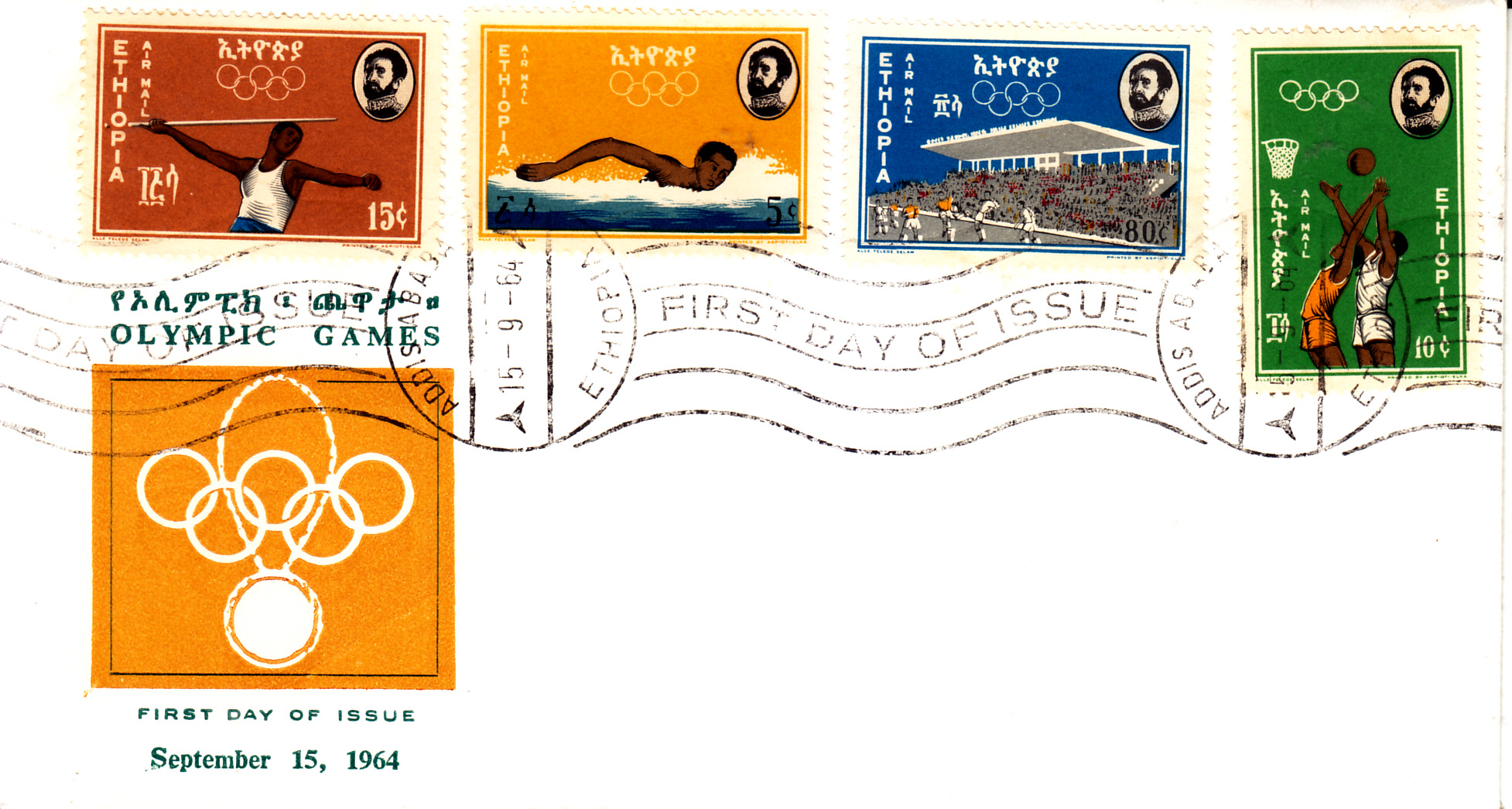
Ethiopian Postal Service Tokyo Summer Olympics

ETHIOPIAN POSTAL SERVICE issued on 15 September 1964 a set of four stamps representing the Tokyo Summer Olympics.

Ethiopia competed at the 1964 Summer Olympics in Tokyo, sending a total of 12 competitors, all men, who took part in eleven events in three sports. Among these being, Abebe Bikila, who repeated as Olympic champion in the men's marathon.

Ethiopian Postal Service The Great Anciant Empresses of Ethiopia

ETHIOPIAN POSTAL SERVICE issued on 2 March 1964 a set of five stamps depicting The Great Ancient Empresses of Ethiopia. The artwork was created by renowned Ethiopian artist, Afewerk Tekle. These multicolour First Day Cover stamps were printed by Courvoisier (Helio Courvoisier) S. A., using a Photogravure method.

The stamps:
- 10c Sheba (990 BC)
- 15c Helen (1500 AD)
- 50c Seble Wongel (1530 AD)
- 60c Mentiwab (1730 AD)
- 80c Taitu (1890 AD)
 

Egypt Definitive Stamps of King Fuad - 1927 to1937

EGYPT between 1927 and 1937 issued a definitive series of the nation's King Fuad. Postmark cancellation on this post card originated from Cairo. Values 1 to 4 are shown here. The post card itself depicts Masjid Muhammad Ali in Cairo.

On another note, seven of the values (1/2/3 olive brown/4 yellow green/5/10 orange red and 15 ultramarine) had differing vignettes. The early printings ("Type I") had vignettes printed from plates with screens of vertical dots. The later printings had screens of diagonal dots ("Type II").
 

Masjid Muhammad Ali Mosque or Alabaster is situated in the Citadel of Cairo, Egypt and was commissioned by Muhammad Ali Pasha between 1830 and 1848.  This Ottoman-era mosque, the largest to be built in the first half of the 19th century, is, with its animated silhouette and twin minarets, the most visible mosque in Cairo. The mosque was built in memory of Tusun Pasha, Muhammad Ali's eldest son, who died in 1816.

Wednesday, October 18, 2023

Egypt Tomb of Aggressors - 1957

EGYPT (United Arab Republic) issued on 26 July 1957 a series of stamps entitled "Tomb of Aggressors". This set was issued to celebrate the end of the Suez War (also called The Tripartite Aggression). The set  represented five important victories of Egyptian troops throughout history.

The stamps included:
Battle of Avaris in 1580 BCE - 10m carmine.
Sultan Saladin at the Battle of Hattin 1187 CE - 10m olive green.
Louis IX of France in Chains at Battle of Mansourah in 1250 CE - 10m brown violet.
Map of the Middle East at Battle of Ain Jalut in 1260 CE - 10m green blue.
Control of the Port Said in 1956 CE - 10m yellow/brown.

Battle of Avaris
The Battle of Avaris stamp represents the Egyptian troops defeating the Hyksos in the city of Avaris in 1580 BCE. The Hyksos were an Arab population, coming from Palestine, who settled progressively in Egypt starting from 1800 BCE in the time of the 12th dynasty. Later, with the weakening of the Egyptian state, they established a kingdom with Avaris as capital. Ahmose I, the founder of the 18th dynasty, defeated the Hyksos and took control of their capital Avaris.

Sultan Saladin at the Battle of Hattin
This stamp shows a drawing of Sultan Saladin on his horse. It commemorates the Battle of Hattin, that often occurred in July 1187 CE, where Saladin achieved a crushing victory over the Crusader armies. In 1099 CE, areas in Syria, Lebanon, Palestine, and Jerusalem in particular, were occupied by the Crusaders in the First Crusade. This occupation lasted for about a century.The direct cause for the Battle of Hattin occurred when  Raynald of Châtillon, the Lord of Oultrejordain, raided a caravan of Muslim merchants while a truce with Saladin was still in place. Saladin asked Guy of Lusignan, the then King of Jerusalem to compensate for the goods and punish his Lord for the truce violation. The king’s refusal led to war which ended in the Battle of Hattin, where the army of Saladdin crushed the crusaders’ army. This decisive victory opened the way for the liberation of Jerusalem and most of the coastal cities in current Palestine, Lebanon and Syria.

Battle of Mansourah
The Battle of Mansourah stamp shows the capture of  King Louis IX. He, along with two of his brothers, Charles d’Anjou and Robert d’Artois, led the Seventh Crusader force. They were joined later by the king’s third brother Alphonse of Poitiers. These forces were mainly French with an English contingent led by William of Salisbury. After their first victory at the Port of Damietta, in June 1249 CE, they were unable to progress into Egypt. In February 1250 CE, they marched towards the city of Mansourah. But the attacking forces fell into a trap and most of them were decimated, including the King’s brother Robert d’Artois, and the English commander William of Salisbury. After a two-month long siege, they tried to retreat to the Damietta, but were attacked by Egyptian forces. The French King, his brothers and tens of French dignitaries were captured, and tens of thousands of combatants were killed.

Battle of Ain Jalut
The Mongol empire emerged in the 13th century in eastern Asia as major power during the rule of Genghis Khan. It expanded rapidly towards central and western Asia and Europe. In few decades, Mongols extended their control over all central Asia and Persia.

After several attacks on Syrian cities starting in 1244 CE, the Mongols besieged Baghdad, occupied and sacked it in 1258 CE. Damascus had a similar fate sometime later. After these victories, the Mongols sent envoys to Cairo demanding the Mamluks, who ruled over Egypt, to surrender.

In anticipation of a Mongol invasion, the Mamluk Sultan of Egypt, Saif ad-Din Qutuz, prepared an army and entered into Palestine. The Egyptian Mamluk and Mongol armies clashed in a locality in the south of the galilee called Ain Jalut. The Mongols were crushingly defeated by Qutuz’s forces, and the Battle of Ain Jalut has been considered a historical turning point in the Mongol invasions.

Control of the Port Said
The Port Said stamp depicts an international agreement, wherby the Anglo-French invading forced had to finish withdrawing by 22 December 1956 CE. The Israeli forces withdrew from Sinai and the Gaza Strip, in March 1957 CE. The withdrawal of foreign troops confirmed Egyptian sovereignty over the Suez Canal. Egyptian resistance at Port Said become a symbol of Egyptian victory, linked to a global anti-colonial struggle.

Tuesday, October 17, 2023

Palestine Philatelic Exhibition Postcard with Stamps in Tel-Aviv 1945

PALESTINE SPECIAL POST CARD FOR PHILATELIC  EXHIBITION is a pictorial postal stationery card with large advertisement for the Phila stamp exhibition. This First Day Cover features three Palestine landmarks: Mosque of Omar (Dome of the Rock), Rachel's Tomb and  Tower of David. Cancellation originated from Tel-Aviv (Palestine) and was dated 8 April 1945. These stamps  were part of a 22-stamp series was printed and released with scenes/sites from Palestine between 1927 till 1942, and apparently they were used up until the late 1940s. The stamps were printed in three languages.
 

Mosque of Omar (Dome of the Rock)
The Dome of the Rock is located on the Temple Mount in the Old City of Jerusalem. It was completed in 691 CE. The Foundation Stone, on which it is built, holds great significance for Muslims, Jews, and Christians. It was constructed on the Second Jewish Temple site, which was destroyed by the Roman army in year 70 CE. Muslims believe this is the site of the Islamic miracle of the Isra and Miraj. Jews believe the Foundation Stone was the location of the Holy of Holies in the Temple, and view it as the epicenter (junction) of Heaven and Earth.  According to Jewish tradition, the stone is the site where Abraham was preparing to sacrifice his son, Isaac. Muslims believe it was Ishmael that was to be sacrificed.) 

Rachel's Tomb
Rachel's tomb (reputed) is within a Muslim cemetery, and is located on the edge of Bethlehem in the West Bank. Rachel, wife of Jacob, and mother of Benjamin, is revered, especially in the Jewish tradition. Rachel's tomb has been the site of Muslim/ Jewish cooperation and conflict, depending on the era. 
Citadel at Jerusalem

This ancient citadel (Tower of David) is located near the Jaffa Gate entrance to the Old City of Jerusalem. It has origins back to the 2nd century BCE. It now houses a Museum of the History of Jerusalem.

Postes Gabon Fang Woman Surtax Stamps - 1932

POSTES GABON on 1 January 1932  issued 11 surtax (postage due) stamps depicting a Fang Woman. Seven of those stamps are represented here  Printers were Hélio-Vaugirard, Paris, using a Photogravure method. Perforation 13 x 13½.

Sunday, October 15, 2023

Hellenic Post 150th Death Anniversary of Lord Byron

HELLENIC POST  on 4 April 1974 issued a series of First Day Cover stamps dedicated to Philhellene Lord Byron. The stamps  commemorated the 150th anniversary of his death. In Greece, Byron is considered a hero in the Greek War of Independence, for which he paid the ultimate price -- he lost his life fighting in the cause of freedom for Greece. One stamp depicts Lord Byron in Souliot costume, the other portrays him addressing soldiers. The cachet shows the house in Missolunghi, where during the Battle of Missolunghi, Byron died.

Byron has been honoured many times in Greek postage stamps as well as in Albania, Armenia, Hungary, Monaco, and Russia, but to my knowledge never in the country of his birth; only a line from one of his poems in the Royal Mail British Romantic Poets series was issued in 2020. Although Byron is recognised as one of the literary greats, if not the greatest, Romantic poet in English literature, he was in the Victorian era controversial due to his many par amours and illegitimate children. Even today, to some extent, he remains controversial.

His only legitimate offspring, Augusta Ada Lovelace neé Byron (Countess Lovelace), was a mathematician and writer, chiefly known for her work on Charles Babbage's proposed mechanical general-purpose computer, the Analytical Engine. She was the first to recognise that the machine had applications beyond pure calculation.  

The uniform worn by Byron in the stamp is of Souliote origin. The Souliotes were an Orthodox Christian Albanian tribal community in the area of Souli in Epirus from the 16th century to the beginning of the 19th century, and who by their participation in the Greek War of Independence came to identify with the Greek nation. They successfully resisted Ottoman rule for many years. At the height of their power, in the second half of the 18th century, the Souliote confederacy is estimated to have consisted of up to 4,500 inhabitants. After the revolution, they migrated to and settled in newly independent Greece, and assimilated into the Greek populace.

Lord Byron (George Gordon Byron, 6th Baron Byron) was the son of English Royal Navy captain, John Byron (Captain John "Mad Jack" Byron), and of his second wife, the Scottish aristocrat Catherine Gordon (Catherine Gordon). As an aristocrat on his mother's side, he was a descendant of King Edward III of England. At the age of ten, in May 1798,  Byron inherited from his grandfather's brother, William Byron, the title of Lord, as well as his very large property in Nottinghamshire. He spoke with a Scottish accent most of his life, owing to his early years and schooling there. He received a Master's degree from Trinity College, Cambridge. Later he traveled extensively across Europe to places such as Italy, where he lived for seven years in Venice, Ravenna, and Pisa after he was forced to flee England.  Byron joined the Greek War of Independence fighting the Ottoman Empire and died leading a campaign during that war. He died in 1824 at the age of 36 from a fever contracted after the first and second sieges of Missolonghi.

Source: Wikipedia

Thursday, October 12, 2023

Pos Indonesia Visit Indonesia Year 1961

POS INDONESIA on 15 May 1961 issued a series of three First Day Cover stamps dedicated to Visit Indonesia Year 1961. A photogravure method was used. Postmark cancellation originated from Bandung.