Sunday, January 14, 2024

Yusei Jiguocho Stamp of Yomei Gate, Tosho Shrine and Postcards of Itsukushima Shrine and Yasukuni Shrine

YUSEI JIGYOCHO (Japan Postal Agency) issued in 1926 a red engraved stamp representing the Yomei Gate, Tosho Shrine, Nikko.
 
Yasukuni Shrine (Yasukuni Jinja, lit. 'Peaceful Country Shrine') is a Shinto shrine located in Chiyoda, Tokyo. It was founded by Emperor Meiji in June 1869 and commemorates those who died in service of Japan, from the Boshin War of 1868–1869, to the two Sino-Japanese Wars, 1894–1895 and 1937–1945 respectively, and the First Indochina War of 1946–1954, including war criminals. The shrine's purpose has been expanded over the years to include those who died in the wars involving Japan spanning from the entire Meiji and Taishō periods, and the earlier part of the Shōwa period.

Of the 2,466,532 people named in the shrine's Book of Souls, 1,068 are war criminals or alleged war criminals including fourteen men charged with Class A war crimes (eleven were convicted on those charges, one was found not guilty of Class A but guilty of Class B, two died during or before trial) by the International Military Tribunal for the Far East, following World War II.
 
The postcard shows the Itsukushima Shrine (Itsukushima-jinja), which is a Shinto shrine on the island of Itsukushima (popularly known as Miyajima), best known for its "floating" torii gate. It is in the city of Hatsukaichi in Hiroshima Prefecture in Japan, accessible from the mainland by ferry. It is said to have been erected in 593 CE supposedly by Saeki Kuramoto during the reign of Empress Suiko (592–628 CE).


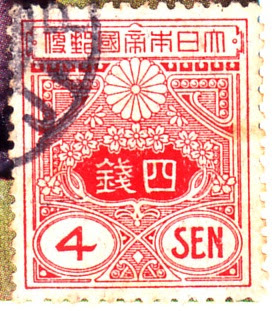
Yusei Jigyocho Red Tazawa Stamp on Geisha "Debayashi" Postcard


YUSEI JIGYOCHO (Japan Postal Agency) issued on  31 October 1913 a series of definitive stamps with the Taisho  Coats of Arms / Chrysanthenum. Initially these stamps had no watermark; later issues did to prevent counterfeiting.  Printing method was simply Typography on white paper. The red stamp shown here had a value of 4 Japanese sen. Size was 21 x 26 mm.

This new series came about with the passing of Emperor Meiji. The new era of Taisho began, thus stamp designs were completely changed. For the first time an open contest with prizes was held to select a new stamp design. An entry by Tazawa Shogen (an employee of the Printing Bureau) was chosen and adopted as the design for the new standard stamps. These stamps are known as the 'Tazawa stamps' after the design's creator.

The stamp on this postcard with geisha "debayashi" musical theatre ensemble (1905). was posted in the early years of Teisho's reign. A debayashi ("on stage") ensemble was made up geisha musicians performing nagauta ("long song") dance music. The ensemble consisted of shinobue (transverse bamboo flute), kotsuzumi (drum played on the shoulder), shamisen (3-string long neck lute), and shimedaiko drum.

Monday, January 8, 2024

Magyar Post Japanese Art

MAGYAR POST on 1971 issued eight First Day Cover stamps depicting Japanese art (Ukiyo-e woodblock print). They were released as perforated and unperforated stamps as well as maxim cards. These Japanese prints were obtained from the Museum of East Asian Art, Budapest. Shown here is a Maxim card depicting the Ama pearl divers of Chiba by Kitagawa Utamaro. Additionally, an FDC with three of those stamps.


Yusei Jigyocho "Commemoration of Peace" Postcard and Stamps - 1919

YUSEI JIGYOCHO (Japan Postal Agency) issued one of two postcards designated  for the "Commemoration of Peace" at the end of WWI in 1918. One of these was two children and white pigeons is entitled "Heiwa Kinen E-Hagaki" by Japanese artist Kiyokata Kaburagi (1878-1973). The printing technique utilised was the woodblock method. Four commemorative stamps were issued. Only one of those stamps is affixed here. The other is an orange Tazawa stamp with overprint from Hebei, China which was issued during the Taisho era.
"Commemoration of Peace" stamp
Tazawa stamp with overprint from Hebei

Nippon Post ``Returning from the Bath in the Rain''

NIPPON POST on 20 April 1958 printed a First Day Cover stamp called "Returning from the Bath in the Rain'' by Japanese artist Kiyonaga Torii (1752-1815). The cachet featured the full Kiyonaga Torii woodblock print. To mark the Philately Week beginning with 20 April 20, this 10 yen postage stamp had for its design a work by Kiyonaga Torii, a ukiyoe artist (1752-1815) of the Yedo period. It was released for sale throughout Japan and by correspondence with the Philatelic Agency, Tokyo Central Post Office.
 
Kiyonaga Torii was a student of Torii Kiyomitsu and the fourth generation successor painter of the Torii school. A figure who belonged to the period between Suzuki Harunobu and Kitagawa Utamaro, active in the Tenmei Dynasty. Torii improved Suzuki Harunobu's paintings of beautiful and pitiful women, and absorbed the characteristics of other artists, changing the beautiful women into slender, realistic and healthy "Qingchangbijin" style beauties. This style had a profound influence on many beauty painters. 


Nippon Post Celebrations in Kyoto

NIPPON POST on 5 January 2003 issued four First Day Cover stamps representing the Kyoto celebrations: Aoi Festival, Gion Festival, Okuribi, Jidai Festival. Each stamp carried a value of 50 yen.

Nippon Post Utamaro Kitagawa Artwork: "Women Working in the Kitchen"

NIPPON POST on 20 April 1983 issued a  First Day Cover se-tent stamp set of the Utamaro Kitagawa artwork entitled "Women Working in the Kitchen". It carried a value of 60 ¥. The Photogravure printing method was used. A total of 11,250,000 stamps were printed.

Nippon Post Modern Art Series, Volume 4: "Harvest" and "Rafu"

NIPPON POST on 22 November 1979 issued a First Day Cover in the Modern Art Series, Volume 4. Two stamps were affixed to the cover:  "Harvest" by   which was 50 ¥ stamp that had a special cancellation postmark: Tokyo Chuo 54.11.22; the other stamp represented in this FDC series was an artwork by Kagaku Murakami (1888-1939) called "Rafu".

France "Japonaise Dénudée Sur Son Lit" Postcard by J. Seeberger

FRANCE postcard of "Japonaise Dénudée Sur Son Lit" by J. Seeberger,  published by Salon de Paris, early 1900s.

Thursday, January 4, 2024

Australia Post 150th Anniversary of the 1868 Aboriginal Team that Toured England

AUSTRALIA POST on 1 May 2018 issued a First Day Cover stamps celebrating the 150th anniversary of the 1868 Aboriginal team that toured the UK continue. The stamp featured 10 Aboriginal members of the original 1868 playing squad, as well as captain Charles Lawrence, an English professional who coached and mentored the Aboriginal players, and team manager W Shepherd. Shown here is a maxim card of the team with the stamp affixed to it.

The stamp design, by Phil Ellett of Creative Ethos, incorporated player portraits from one of the few remaining photos of the Aboriginal XI taken while on tour in 1868, from the collection of the National Library of Australia. The portrait shows  the team in July 1868, midway through their tour, along with their manager. It does not feature King Cole (Bripumyarrimin) who contracted a fatal case of tuberculosis early in the tour, nor Sundown (Ballrinjarrimin) or Jim Crow (Lytejerbillijun) who returned home soon after. The background of the stamp design is a fence typical of those that existed at the sporting fields at the time, taken from a photograph of the Lord’s ground in England.
 
Altogether, the 1868 Aboriginal XI played 47 matches throughout England over a period of six months, winning 14, losing 14 and drawing 19; a good result that surprised many at the time. Their skills were said to range from individuals who were exceptional athletes down to two or three other team members who hardly contributed at all. The outstanding player was Johnny Mullagh. He scored 1,698 runs and took 245 wickets. An admired English fast bowler of the time, George Tarrant, bowled to Mullagh during a lunch interval and later said, "I have never bowled to a better batsman."

Source: Australian Cricket

Thailand Post "Thai Hill Tribes"

THAILAND POST in 1972 issued a First Day Cover commemorative set of four stamps called "Thai Hill Tribes".

Thai Hill Tribe is a term used in Thailand for all of the various ethnic groups who mostly inhabit the high mountainous northern and western regions of Thailand, including both sides of the border areas between northern Thailand, Laos and Burma, the Phi Pan Nam Range, the Thanon Range (a southern prolongation of the Shan Hills), as well as the Tenasserim Hills in Western Thailand. The seven major hill tribes in Thailand are the Akha (shown), Lahu, Karen, Hmong/Miao (shown), Mien/Yao (shown), Lisu, and Palaung, each with a distinct language and culture.

Wednesday, January 3, 2024

UK Cover Letter Famous British Persons 2023

Cover letter of assorted stamps from showing famous British women, 400th Anniversary of Welsh Bible translators  and British TV show host of 'Muffin the Mule'. These stamps were issued in 1988, 1996 and and 1997, respectively. I received this cover in January 2024.


Japan Cover Letter - 2023


Cover letter from Japan with an assortment of stamps showing different topics. Received in late December 2023.