Monday, October 25, 2021

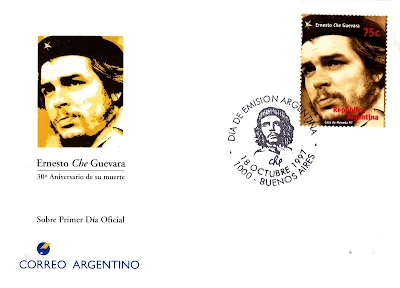
Correos Argentina 30th Death Anniversary of Ernesto Che Guevara

CORREOS ARGENTINA on 9 October 1997 issued a 30th anniversary stamp marking the  death of Ernesto Che Guevara. Hundreds of people purchased some 18,000 stamps, whose value was 75 cents. The first day cover sold out on the first day of sale. Although Guevera was a native son of Argentina, his image was prohibited in this South American nation in the previous decades.

Dr. Ernesto "Che" Guevara (1928 - 1967) was an Argentine Marxist revolutionary, physician, author, guerrilla leader, diplomat, and military theorist. He is one of history's more revered and reviled historical figures, depending largely on one's political perspective. His conflicting actions also contribute to the controversy. After the Cuban Revolution, of which he was a key proponent, Guevara performed a number of key roles in the new government. These included reviewing the appeals and firing squads for those convicted as war criminals during the revolutionary tribunals, instituting agrarian land reform as minister of industries, helping spearhead a successful nationwide literacy campaign, serving as both national bank president and instructional director for Cuba's armed forces, and traversing the globe as a diplomat on behalf of Cuban socialism. Such positions also allowed him to play a central role in training the militia forces who repelled the Bay of Pigs Invasion, and bringing Soviet nuclear-armed ballistic missiles to Cuba, which preceded the 1962 Cuban Missile Crisis. Additionally, Guevara was a prolific writer and diarist, composing a seminal guerrilla warfare manual, along with a best-selling memoir about his youthful continental motorcycle journey. His experiences and studying of Marxism–Leninism led him to posit that the Third World's underdevelopment and dependence was an intrinsic result of imperialism, neocolonialism, and monopoly capitalism, with the only remedy being proletarian internationalism and world revolution.

As a result of his perceived martyrdom, poetic invocations for class struggle, and desire to create the consciousness of a "new man" driven by moral rather than material incentives,  Guevara has evolved into a quintessential icon of various leftist movements. In contrast, his ideological critics on the right accuse him of promoting authoritarianism and endorsing violence against his political opponents. Despite disagreements on his legacy, Time magazine named him one of the 100 most influential people of the 20th century.

Eventually, in early October 1967, Guevara was captured and executed in Bolivia. A Cuban exile turned CIA Special Activities Division operative, advised Bolivian troops during the hunt for Guevara in Bolivia. An informant apprised the Bolivian Special Forces of the location of Guevara's guerrilla encampment in the Yuro ravine. He was sick, wounded and imprisoned, then executed a few days later by firing squad on 9 October 1967.

Personally, and to a certain extent, I can empathise with Ernesto Che Guevara. There is and was much social injustice that needs(ed) to be righted in this world. Capitalism -- and Marxist Communism -- can be both forces for constructive change; but, as so often has been the case, certain individuals who may have had the sincerest intentions to correct those wrongs eventually become part of the problem and perverted the ideology they espoused. Che Guevara was no different. He recognised, or so he believed, what those socioeconomic ills were, subscribing to Marxist revolution as the force for change. He however could be ruthless and uncompromising, and this perhaps more than anything else contributed to his downfall. Still, he remains a legend...an iconic role model for socioeconomic justice in many parts of the world.


Papua New Guinea Centenary of Radio

PAPUA NEW GUINEA 11 September 1996 released a First Day Cover of four stamps to commemorate the centenary of radio. These colourful stamps featured a radio control tracking desk, radio transmitter with pedal powered generator, satellite dish and radio DJ. A brochure accompanied  this FDC with details about the stamps and the write up on the  centenary of radio in Papua New Guinea.


Saturday, October 23, 2021

Pos Malaysia Mel Rakyat Campaign

FREE MEL RAKYAT SHEETS!!! AVAILABLE ONLY IN MALAYSIA.  

Mel Rakyat was launched by Pos Malaysia in conjunction with this year’s World Post Day which is celebrated on 9 October every year to mark the anniversary of the establishment of the Universal Postal Union in 1874

The Mel Rakyat campaign, which runs from Oct 4 to 31, is themed “Celebrating Legacy, Connecting the Future”. 

I've already written one to my grandson. Will be writing more and sending soon, God willing.

Friday, October 22, 2021

Vietnam Post Miscellaneous Stamps

VIETNAM POST stamps received from a fellow stamp collector.
 

Viet Nam Post Costumes of Vietnamese Women


VIETNAM POST (Department General of Posts and Telecommunications) on 1 February 1995 issued a first day cover stamp set entitled "Costumes of Vietnamese Women ". The set consisted of three values, depicting three typical styles of long-split tunics, designed for girl studenrs, bridal  wedding ceremony and fashionable design. The white colour is used to highlight the purity, grace and beauty of Vietnamese women in traditional costume. This series was designed by Mr. Tran The Vinh (staff painter of Vietnam Stamp Corporation), with  stamp sises of 31x46 (mm) and FDC's size of 180x105 (mm). Shown on the FDC stamps and cachet are Vietnamese women collecting lotus flowers.
 
Why the Lotus? Aside from being the national flower of Vietnam and found throughout the country, the lotus symbolises the physical beauty and soul of Vietnamese women. It is similar to a Vietnamese woman in a long, slender dress, with a hat on her head and hand holding a lotus flower. The lotus is also like so many Vietnamese women who have the humility and strength to endure hardship and  sacrifice, yet are demure and project outstanding beauty. 

Viet Nam Post 48th Anniversary of ASEAN

VIET NAM POST on 8 August 2015 issued a first day cover stamp to commemorate the 48th founding of ASEAN. Shown here is the stamp affixed to a maxim card showing the distinctive landmarks in each of the ASEAN nations.

Artists Vu Kim Lien and Nguyen Du from the Viet Nam Post Corporation (Viet Nam Post) designed the official stamp and postmark. A contest was organised by the Thailand Post with joint efforts from the Posts of other nine ASEAN countries to select a design which was won by these two Vietnamese artists.

The ten flags of the ASEAN country members make up the main pattern of the stamp, stitched together to become a flower, said Vu Kim Lien, adding that yellow cornflowers are stylised behind the main pattern to represent the substantial potential of ASEAN members to develop their agricultural economies.

The Vietnamese designs, closely reflect the ASEAN’s motto of “One vision, one identity, one community”, and play a crucial role in enhancing Viet Nam’s prestige in culture and art, said Nguyen Quang Vinh, Deputy Head of the postal stamp board under the Viet Nam Post.

Viet Nam Post Vietnamese Traditional Costumes -- Ao Dai

VIET NAM POST on 8 August 2019 issued a first day cover stamp, in conjunction with other ASEAN nations, entitled the National Costumes of ASEAN. Affixed to this maxi card is the traditional wedding attire -- Ao Dai -- worn by Vietnamese couples.

The Viet Nam Ministry of Information and Communications decided to issue a stamp called "Vietnamese Traditional Costumes",  with the face price of 4,000.- VND, to honor the beauty of Ao Dai and aid in the preservation of Vietnamese traditional costumes.

Viet Nam is a country that has a long history with a unique culture and imbued with national identity. This is clearly reflected in the richness and the diversity of the traditional costumes. In which, Ao Dai is considered as Vietnamese national dress. Ao Dai is made for both men and women which is often worn on format festivals, fashion shows or as school uniforms. Historical records reveal the Ao Dai has changed over time, yet it still suits one and all in society. Even so, Ao Dai remains a symbol of the beauty, culture and  pride of  the Vietnamese people.

Date of Issue: 8 August 2019
Stamp Size: 46 mm x 31 mm
FDC Size: 180 mm x 110 mm
Stamp Designer: Mr. Pham Trung Ha

Wednesday, October 20, 2021

Helvetia Post 50th Anniversary of Swiss Radio International

HELVETIA POST in 1985 released an FDC marking the 50th anniversary of Swiss Radio International (SRI).

Nineteen years later, on 30 October 2004, Swiss Radio International ceased to broadcast its shortwave and satellite radio programmes -- after nearly 70 years! Swiss Radio International first broadcast to the world on shortwave in 1935. The station made a name for itself as a neutral voice of authority during  World War II and throughout the Cold War. Programmes were broadcast in nine languages (German, French, Italian, Romansh, English, Spanish, Portuguese, Arabic and Esperanto). During this time, SRI established itself as one of the most high-profile and popular international radio broadcasters. The end of the Cold War, coupled with the advent of satellite technology and the internet revolution, spelled the end of the shortwave era for SRI.

I was one of many worldwide listeners who caught the broadcasts of SRI, first in the United States, back in the 1960s. Later, in  the 1980s and up until their last transmission, I listened in Malaysia where their transmissions were regularly heard, loud and clear. Since the end of SRI's shortwave service I have not bothered to catch any of their web-based content.

Wednesday, October 13, 2021

Ascension Island Inauguration of BBC Relay Station on Ascension

ASCENSION ISLAND on 1 December 1966 issued four first day cover stamps marking the opening of BBC Relay Station on Ascension. The images of Queen Elizabeth II and Lion with BBC emblem are gold embossed against four different colours (blue, green, red and purple) and corresponding to the individual monetary denominations - 1D, 3D, 6D and 1,6. The cachet depicts an illustration of Ascension Island with radio waves radiating from the island. Above the island is the heraldic crest of BBC Ascension Island.
 
 In the mid-1960s, the BBC built the relay station at English Bay on the northern tip of the island to transmit shortwave radio broadcasts to Africa and South America, plus a power station to provide the electricity.

Four of the towers supporting HF curtain arrays on easterly bearings to Africa. The towers vary from 60 to 125 meters in height. For more than 50 years, the Atlantic Relay Station has transmitted critical radio broadcasts to millions of listeners in some of the remotest parts of Africa.

The shortwave transmitters include two 250 kW Marconi BD272 transmitters originally installed in 1966 (and still in daily use) and four 250 kW RIZ K01 transmitters, which are also capable of transmitting in Digital Radio Mondiale mode.

Each transmitter can be switched to one of more than 20 antennas, which consist of HF curtain arrays beaming toward target areas in Africa and South America. Programming from London is delivered via satellite, with resilience and backup feeds.

Sunday, October 10, 2021

Sahara Espanol Correos Dia Del Sello


SAHARA ESPANOL on 23 November 1973 issued two first day cover stamps entitled Dia Del Sello.

Friday, October 8, 2021

Republique du Niger "Promotion Humaine - Radio Clubs of Niger"

Although these four stamps were issued in 1965, they literally illustrate the vital role that radio communication still plays in society wherever one may be in the world, not just this developing nation in Africa.

In many parts of the world, radio is still a more affordable medium than the alternative, i.e. computers, internet, cellphones. Additionally, the infrastructure for these devices we take for granted in more developed countries just does not exist or is limited to those who have the money and/or social/political position.

This was highlighted to me a few years back when communicating with the station director at a radio station on the South Pacific island of New Ireland (Papua New Guinea). Only a few folks had a cellphone, internet was down most of the time, roads could be impassable due to flooding, tropical heat and humidity was corrosive to electric devices, but radio was available and cheaply replaced if necessary to almost everyone on the island.

More importantly, radio had the  reach to inform and entertain the people on this island. And mind you, it was radio with short-wave and medium-wave radio bands, not FM, as radio signals radiate further on these frequencies and over obstacles like hills/mountains, so much so that a listener like me, thousands of miles away, in Malaysia was able to receive their broadcasts.

That said, I often find postage stamps such as these historically interesting, and in some cases still relevant in promoting/disseminating a message to a nation's population. In 1965, these stamps  certainly would have been informative to the people in Niger. The social settings, the  clothing, etc would have been things they could relate to. And, these four stamps dedicated to "Promotion Humaine - Radio Clubs of Niger", i.e. recording music/songs, listening to radio transmissions, public debates and interviews intended for radio broadcasts, would have been topical in the day.

Anyway, that's how the old advertising/marketing guy in me looks at it and occasionally skews the world at large.

Thursday, October 7, 2021

Sierra Leone Postal Authority 100th Memorial Anniversary of Mata Hari

SIERRA LEONE POSTAL AUTHORITY on 27 February 2017 issued a series of first day cover stamps and a mini sheetlet marking the 100th Memorial Anniversary of Mata Hari. Although these offset lithographs were authorised by the postal administration of Sierra Leone, the issue was not placed on sale in Sierra Leone, and was only distributed to the new issue trade by Sierra Leone's philatelic agent.

 Margaretha Geertruida MacLeod née Zelle (1876 – 1917), better known by the stage name Mata Hari, was a Dutch exotic dancer and courtesan who was convicted of being a spy for Germany during World War I. Many people still believe she was innocent because the French Army needed a scapegoat for their losses in the war.

In 1917, France had been badly shaken by the Great Mutinies of the French Army in the spring of 1917 following the failure of the Nivelle Offensive together with a huge strike wave, and at the time many believed that France might simply collapse as a result of war exhaustion. In July 1917, a new government under Georges Clemenceau had come into power, utterly committed to winning the war. In this context, having one German spy on whom everything that went wrong with the war so far could be blamed was most convenient for the French government, making Mata Hari the perfect scapegoat, which explains why the case against her received maximum publicity in the French press, and led to her importance in the war being greatly exaggerated.

Zelle wrote several letters to the Dutch Ambassador in Paris, claiming her innocence. "My international connections are due of my work as a dancer, nothing else .... Because I really did not spy, it is terrible that I cannot defend myself."

Canadian historian Wesley Wark stated in a 2014 interview that Mata Hari was never an important spy and just made a scapegoat for French military failures which she had nothing to do with, stating: "They needed a scapegoat and she was a notable target for scapegoating."

Likewise, British historian Julie Wheelwright stated: "She really did not pass on anything that you couldn’t find in the local newspapers in Spain." Wheelwright went on to describe Zelle as "... an independent woman, a divorcee, a citizen of a neutral country, a courtesan and a dancer, which made her a perfect scapegoat for the French, who were then losing the war. She was kind of held up as an example of what might happen if your morals were too loose.”

She was put on trial on 24 July 1917, accused of spying for Germany, and consequently causing the deaths of at least 50,000 soldiers. Although the French and British intelligence suspected her of spying for Germany, neither could produce definite evidence against her. Ultimately she was executed by firing squad in France. Mata Hari's sealed trial and related other documents, a total of 1,275 pages, were declassified by the French Army in 2017, one hundred years after her execution.


Wednesday, October 6, 2021

Sri Lanka Post Colombo Lotus Communications Tower

SRI LANKA POST in 2019 issued a single first day cover stamp marking the inauguration of the Colombo Lotus Tower, a communication tower located in the capitol of this South Asian nation. This iconic tower of Sri Lanka is the tallest self-supported structure in South Asia; the second tallest structure in South Asia after the guy-wire-supported INS Kattabomman in India; the 11th tallest tower in Asia and the 19th tallest tower in the world. The lotus-shaped tower is used for communication, observation and other leisure facilities. The tower is 350 m (1,150 ft) tall and covers 30,600 m2 (329,000 sq ft) of floor area.


The Lotus Tower's main revenue sources will be tourism and antenna leasing. It will function as a radio and television broadcasting antenna ISDB-T and proposed DVB-T2 support structure for 50 television services, 35 FM Radio Stations and 20 telecommunication service providers, and it will house a variety of tourist attractions.

The design of the tower is inspired by the Lotus flower. The lotus symbolises purity within Sri Lankan culture and is also said to symbolise the country's flourishing development. The tower base is inspired by the lotus throne and will also be formed by two inverted trapezoidal The tower's color is planned to alternate between pink and light yellow by smooth transition- an effect achieved by coating the glass.


Source: Wikipedia