Thursday, March 24, 2022

USPS The Spirit of Seventy-Six

USPS on 1 January 1976 issued a three-stamp se-tenant honouring the Spirit of Seventy-Six. This se-tenant depicted the famous oil painting by Archibald M. Willard of a fife player and two drummers, leading American troops during the American Revolutionary War. The original painting hangs in the Selectmen’s Room in Marblehead, Massachusetts. The cancellation postmark for this first day issue originated from Pasadena, California. The Bureau of Engraving and Printing printed 73,151,667 using the photogravure method. It featured 11 perforations and it was blue violet and multicoloured. 

During the American Revolution, patriot Thomas Paine opined in the first of 13 pamphlets from 1776 till 1781: "These are the times that try men's souls. The summer soldier and the sunshine patriot will, in this crisis, shrink from the service of their country; but he that stands by it now, deserves the love and thanks of man and woman. Tyranny, like hell, is not easily conquered; yet we have this consolation with us, that the harder the conflict, the more glorious the triumph. What we obtain too cheap, we esteem too lightly: it is dearness only that gives every thing its value. Heaven knows how to put a proper price upon its goods; and it would be strange indeed if so celestial an article as FREEDOM should not be highly rated."

This particular pamphlet American Commander-in-Chief General George Washington ordered to be read aloud to American soldiers on 23 December 1776, before the Battle of Trenton. With the success of the ongoing revolution in doubt a week earlier, his army had seemed on the verge of collapse. The dramatic victory inspired soldiers to serve longer and attracted new recruits to the ranks. The victory in turn also motivated patriots and sympathisers of the newly formed United States.


USPS The Boston Tea Party

USPS on 4 July 1973 issued a set of four stamps commemorating the Boston Tea Party. This marked the second time the US post office used four separate designs to create one larger scene. These stamps depict the drama of the night in 1773 when enraged colonists, dressed as Mohawk Indians, dumped chests of tea into Boston Harbor in protest of an English-levied tax. The cancellation postmark for this first day cover originated in Boston Massachusetts. The Bureau of Engraving and Printing printed 49,068,750,000 in a lithographed, engraved method with 11 perforations, in black and multicolour.

On 16 December 1773, a group of Massachusetts colonists known as the Sons of Liberty staged a dramatic protest against British taxes – the famed Boston Tea Party.

The French and Indian War left Britain in debt. So taxes were levied on the New World colonies, which enraged colonists as they had no say in government. The slogan, “No taxation without representation,” became popular in Massachusetts and protests were staged. In 1770, British soldiers fired on a group of angry patriots, killing five of them. The Boston Massacre, as it came to be known, sparked public sentiment against the British.

Britain continued to impose new tea taxes on the colonies. The colonists weren’t simply upset at the taxes themselves, but a number of important factors. For one, they didn’t believe Parliament should have the authority to tax the colonies if they didn’t have a representative there to act in their interests. Also, Britain had essentially formed a tea monopoly (by only allowing colonies to buy from one source) and colonists feared this could later extend to other goods.

In the early fall of 1773, Britain sent seven ships carrying 600,000 pounds of tea to the colonies. Protesters met with the consignees (colonial merchants who would sell the incoming tea) and convinced many of them to resign and send the arriving tea back to England. In fact, they resigned everywhere except Massachusetts. The colonial governor there refused to back down and convinced his consignees not to resign. On 29 November  when the tea ship arrived in Boston Harbor, Samuel Adams called for a meeting. Thousands turned out, and Adams presented a resolution, urging the ship’s captain to take the tea back to England. The governor refused to allow the ship to leave without paying the duty.

Unfazed by the governor’s resistance, Adams called another meeting on 16 December. But upon hearing that the governor once again refused to let the ships leave, Adams declared that “this meeting can do nothing further to save the country.” Shortly after some 100 to 130 men left the meeting for the harbor. Some of them painted their faces and donned the clothes of Mohawk Warriors. After dark, they boarded the three British ships, and dumped all 342 chests of tea into the harbor. The tea was valued at 9,000 pounds sterling – a tremendous sum of money.

It’s been debated whether Adams helped plan the Boston Tea Party or not. Either way, once it was over, he widely publicised and defended it. Similar “tea parties” soon took place elsewhere in America, and the British government was outraged. Following the Boston Tea Party, the British Parliament decided on harsher means to make the colonies more cooperative. Parliament passed a series of laws they called the Coercive Acts – bluntly called the Intolerable Acts by American patriots. These laws greatly restricted the colonies, particularly Massachusetts, which lost its self-government and commerce.

Colonists felt the rules were a threat to their rights, and formed the First Continental Congress to discuss the situation. This led to greater unity among the colonies and increased support for independence, setting the stage for the Revolutionary War.


Source: Mystic Stamps

Wednesday, March 16, 2022

USPS American Bicentennial Souvenir Sheets

USPS on 29 May 1976, issued four souvenir sheets to commemorate INTERPHIL ‘76 (Seventh International Philatelic Exhibition) in Philadelphia, Pennsylvania.  Each sheet contained five individually perforated stamps, which were valid for postage.  Since the U.S. was celebrating its 200th anniversary of Independence, four famous Revolutionary War paintings were appropriately chosen as design subjects for the sheets.

 Each sheet measures  6 x 8 inch. The stamps created by the perforations in the sheet are the standard commemorative size of .84 by 1.44 inches or 21.4 by 36.5 millimeters. They are arranged in vertical and horizontal combinations on three of the sheets. All five stamps are vertical for the surrender of Cornwallis sheet. “USA” and the denomination appears in a corner of each stamp.

The sheets are being produced by a combination of offset and intaglio printing. The paintings are being reproduced by offset, and the “USA” and denomination by intaglio on a Giori press.

The first sheet, "The Declaration of Independence" which contained five 13-cent stamps, featured a reproduction by John Trumbull. The painting shows 42 of the 56 signers of the Declaration; Trumbull originally intended to include all 56 signers but was unable to obtain likenesses for all of them. He also depicted several participants in the debate who did not sign the document, including John Dickinson, who declined to sign.

The second sheet, which contained five 13-cent stamps, featured a reproduction of "Washington Crossing the Delaware" by Emanuel Leutze and Eastman Johnson. The painting commemorates General George Washington's crossing of the Delaware River with the Continental Army on the night of 25–26 December  1776, during the American Revolutionary War. That action was the first move in a surprise attack and victory against Hessian forces at the Battle of Trenton in New Jersey on the morning of 26 December.

The third sheet, which contained five 13-cent stamps, featured a reproduction of "Washington Reviewing the Ragged Troops at Valley Forge" by William Trego.  The March to Valley Forge, December 19, 1777 is one of the most iconic paintings of the Revolutionary War. Painted by Philadelphia artist William B. T. Trego in 1883, the scene shows the Continental Army limping into their winter encampment at Valley Forge. Washington is at the centre.

The fourth and final sheet, which contained five 13-cent stamps, featured a reproduction of John Trumbull’s painting “The Surrender of Cornwallis at Yorktown.”  Picturing the moment that “ended the war,” the scene shows American and French officers, including Washington, lined up to receive the British surrender.

In total, the U.S. Bicentennial was a series of celebrations during the mid-1970s that commemorated the historic events leading to America’s independence from Great Britain. The official events began on 1 April 1975, when the American Freedom Train departed Delaware to begin a 21-month, 25,338-mile tour of the 48 contiguous states. For more than a year, a wave of patriotism swept the nation as elaborate firework displays lit up skies across the U.S., an international fleet of tall-mast sailing ships gathered in New York City and Boston, and Queen Elizabeth made a state visit. The celebration culminated on 4 Jul 1976, with the 200th anniversary of the adoption of the Declaration of Independence.
 
The USPS issued 113 commemorative stamps over a six-year period in honor of the U.S. bicentennial, beginning with the American Revolution Bicentennial Commission Emblem stamp (U.S. #1432). As a group, the Bicentennial Series chronicles one of our nation’s most important chapters, and remembers the events and patriots who made the U.S. a world model for liberty.


 Source: Mystic Stamps

Wednesday, March 2, 2022

USPS 150th Anniversary (1862-2012) of the American Civil War

USPS on 24 April 2012 continued to issue the Civil War Series of stamps commemorating the 150th anniversary of the War between the States. Two stamps were released: The Battle on Antietam and The Battle of New Orleans. These multicoloured, offset stamps were printed by Ashton Potter, with a die cut of 11 perforations.

As the war entered its second year, the Federal government launched its first massive campaign to defeat the Confederacy. The North and South each had one million men facing off along a battlefront stretching from Virginia to Missouri. The loss of lives was enormous – five of the war’s bloodiest battles occurred in 1862, resulting in over 119,000 casualties.

The Battle of Antietam (17 September 1862)
The Confederacy fought back hard. Most of the battles had occurred on its territory. General Robert E. Lee decided it was time to take the war to the Union. His invasion ended in defeat with the Battle of Antietam, which was the single bloodiest battle on American soil at that time.
 
McClellan continued to overestimate the strength and size of his opponent. Lincoln had grown frustrated with his top general, but was heartened by the victories of Ulysses S. Grant in the West. His hopes were further buoyed by the victory of the ironclad Monitor in the Battle of Hampton Roads.

The Battle of New Orleans
Although neither side prevailed, two events eventually changed the war’s course. Union forces captured New Orleans and took control of the Mississippi River in April. This was followed on 1 January 1863, by the Emancipation Proclamation, which barred slavery throughout the Confederacy.

Monday, February 28, 2022

USPS Buffalo Soldiers

USPS on 22 April 1994 issued a commemorative stamp honouring the first African-American soldiers of the U.S. Army, known as 'Buffalo Soldiers', a name Native Americans assigned to them for their tenacity in battle. The cancellation postmark for this first day issue originated from Dallas, Texas.

On 21 September 1866, the 9th and 10th Cavalry units and the 38th, 39th, 40th, and 41st Infantry units (later consolidated as the 24th and 25th Infantry) were formed.  The units were comprised entirely of black soldiers – the first to serve in a peacetime army.  They would come to be known as Buffalo Soldiers.

These two cavalry regiments and four infantry regiments were created by President Andrew Johnson and Congress after freed black slaves had proven their bravery during the Civil War.

For more than 20 years, these courageous men were a valuable part of developing the Great Plains and Southern Plains of the West. Overcoming numerous obstacles, including extreme discrimination and inferior uniforms, military equipment, and horses, these troops developed into remarkable fighting units.

The Buffalo Soldiers patrolled over 7.5-million square acres of land ranging from outposts in Texas to the Dakota territories. They figured prominently in the Indian Wars and strove to make life secure on the strife-ridden frontier of the American West. They fought not only Native Americans, but cattle thieves, bootleggers, and Mexican revolutionaries. Buffalo Soldiers are recognized for playing a key role in “winning” the West.

Paving the way for settlers heading west, these troops also surveyed the land, built railroads, forts, towns, and roads, and escorted stagecoaches, the mail, and wagon trains. Often as difficult to bring down in a fight as the hard-charging buffalo, their Native American opponents dubbed the men “Buffalo Soldiers” – a title they wore with pride.

The regiments were among the most decorated in US military history.  Eighteen black soldiers received the Medal of Honor.  These units also had the lowest desertion rate in the Army from 1867 to 1898.

After the Indian Wars ended, the Buffalo Soldiers continued to serve their country. They participated in the Spanish-American War, fighting in the Battle of San Juan Hill. Buffalo Soldiers were also some of the nation’s first park rangers.

In all, about 500 Buffalo Soldiers worked in Yosemite and nearby Sequoia National Park around the turn of the century. Their duties included removing poachers and timber thieves, stopping illegal grazing, putting out forest fires, constructing roads, trails, and some buildings. They built the first usable road into Giant Forest. These men were some of America’s first park rangers, whose jobs were made much more difficult by lingering racism following the Civil War.

Buffalo Soldiers continued to serve their country and saw combat in both World Wars and the Korean War.  The last units were disbanded in 1951 when the US military stopped segregating troops.


Source: Mystic Stamps

USPS Centenary Anniversary of the Trans-Mississippi


USPS on 18 June 1998 issued a series of 100th anniversary of  the Trans-Mississippi commemoratives.  To publicise this event, a set of nine commemorative stamps was issued. Each was printed in a single color and featured a lithograph/engraving depicting a different western scene.   Banknote Corporation of America printed the stamps. The cancellation postmark originated from Anaheim, California. Shown here with the stamps are the Panda cachets.

The Trans-Mississippi Exposition was held in Omaha, Nebraska, June 1 through November 1, 1898. Its goal was to further the progress and development of resources west of the Mississippi.
 
The original intent for the 1898 issues was to print them in two colours. However, due to the Spanish-American War and the increased demand for revenue stamps, resources were re-allocated and the stamps were printed in one color. The 1998 issues have been printed in two colors, using the only existing original bi-color dies.


Thursday, February 24, 2022

USPS Centennial Anniversary of the Sinking of the USS Maine


USPS on 15 February 1998 issued a 32-cent stamp commemorating the centennial anniversary of the sinking of the USS Maine which lead to the Spanish-American War. It was captioned with the headline "Remember The Maine". The image of the ship comes from an 1898 bandanna. This stamp was the only one issued on the centennial of the Spanish-American War, although the stamp didn't bear any explanation of the USS Maine’s relevance to the war.  

The cancellation postmark for the first day of release was Key West, Florida. The Bureau of Engraving and Printing printed 30,000,000 stamps. Printing Method of this red and black stamp was lithographed and engraved with 11.2 x 11 perforations. The cachet shown her depicts the explosion that took place.

The USS Maine had arrived in Havana, Cuba, in 1898 to serve American interests in the Cuban revolt against Spain. The ship sunk on 15 February 1898, when her forward gunpowder magazines exploded, killing 266 out of 350 crew members. At the time, the American public blamed Spain for the accident, but today the cause of the incident is considered a mystery. A court of inquiry found that the blast was caused by a mine, and many historians think the explosion was the result of spontaneous combustion in a coal bunker.

Subsequently, with the aid of "yellow journalism" propagated by Randolph Hearst and Joseph Pulitzer, the USS Maine became the provocation for the U.S. to declare war on Spain two months later. The American press frequently had printed stories exaggerating Spain’s oppression of Cubans. This “yellow journalism”  was used to create more exciting news stories and increase newspaper sales. As a result, many Americans wanted to intervene in the conflict.

Additionally, some Americans wanted the U.S. to become an imperial power and create naval and military bases in Cuba. President William McKinley pressured Spain to give Cuba limited self-rule. This was granted in November 1897. This act only further complicated the conflict, as pro-Spain Cubans began rioting in Havana in protest.

 The situation in Cuba led President McKinley to send the battleship USS Maine to protect American interests. The ship arrived in Havana Harbor on 25 January  1898. On 15 February 1898, the USS Maine mysteriously exploded while moored in Havana Harbor. The American press blamed a Spanish mine, popularising the slogan “Remember the Maine. To hell with Spain!”

On 25 April 1898, America formally declared that a state of war had existed with Spain since 21 April. By August, the Spanish had surrendered.

Wednesday, February 16, 2022

USPS Bicentennial Anniversary of Sacajawa

USPS on 18 October 1994 issued a bicentennial first day cover stamp in  honour of Sacajawea, a Native-American woman who greatly assisted in the Lewis and Clark Expedition between 1804 and 1806 while traveling in Indian territory. It was postmarked in Tucson, Arizona. Artist Alvin Eckert get created the colour painting printed on cachet. Cover was franked with 29 cent Sacajawea stamp # 2869s (FDOI).

Additionally, this cover includes  SS SACAJAWEA memorial WWII Liberty Ship. The ship cover is one of a group honouring WWII Liberty Ships named for famous Americans. The Liberty Ship named after her was built in Portland, Oregon and delivered on December 29, 1942. The proud vessel transported vital supplies to the US and Allied Forces overseas during WW II. The ship carried post-war commercial cargo until scrapped in 1961.

Sacajawa (or Sacagawea) was famous as a Shoshone woman  born in 1788 and was taken as the non-consenting wife of a Quebecois trapper. She was pregnant with her first child and her son was born during the winter of 1804-1805 in Fort Mandan. When the Lewis and Clark expedition reached the Shoshone tribe, the chief they met was Sacajawea's brother. He provided them with the horses to cross the Rocky Mountains. This story is very long, but the main point is 
that Sacajawea was a very important member of this expedition. 


USPS Bicentennial Anniversary of Lewis & Clark Expedition

USPS in May 2004 issued a series of stamps marking the Bicentennial Anniversary of the Lewis & Clark Expedition.

The Lewis and Clark Expedition from 31 August 1803 till 25 September 1806, also known as the Corps of Discovery Expedition, was the United States expedition to cross the newly acquired western portion of the country after the Louisiana Purchase. The Corps of Discovery was a select group of U.S. Army and civilian volunteers under the command of Captain Meriwether Lewis and his close friend Second Lieutenant William Clark. The expedition made its way westward, and crossed the Continental Divide of the Americas before reaching the Pacific Coast.

President Thomas Jefferson commissioned the expedition shortly after the Louisiana Purchase in 1803 to explore and to map the newly acquired territory, to find a practical route across the western half of the continent, and to establish an American presence in this territory before European powers attempted to establish claims in the region. The campaign's secondary objectives were scientific and economic: to study the area's plants, animal life, and geography, and to establish trade with local Native American tribes. The expedition returned to St. Louis to report its findings to Jefferson, with maps, sketches, and journals in hand.

Source: Wikipedia 


USPS Bicentennial Anniversary of the Louisiana Purchase

USPS in 2003 issued a commemorative stamp marking the 200th anniversary of the Louisiana Purchase.

The Louisiana Purchase
In 1803, the United States purchased the Louisiana Territory from France, acquiring more than 800,000 square miles of land extending from the Mississippi River to the Rocky Mountains. The price was about $15 million – a remarkable bargain. In fact, the Louisiana Purchase has been called the greatest real estate deal in history. Thirteen U.S. states were carved from this massive land purchase, including most of Oklahoma (the panhandle area of the state was not acquired until after the Mexican-American War.
 
Historians consider the purchase the most important event of U.S. President Thomas Jefferson’s first administration, if not his presidency. France’s Napoleon Bonaparte sold Louisiana to raise money to support his military ventures in Europe. Jefferson believed the U.S. Constitution did not grant the government power to make such a purchase, and in doing so, felt he had “stretched the Constitution ‘till it cracked.” However, he felt the benefits to the nation outweighed such a violation of the Constitution.
 
In a message to Congress, Jefferson said, “Whilst the property and sovereignty of the Mississippi and its waters secure an independent outlet for the produce of the Western States and an uncontrolled navigation through their whole course... the fertility of the country, its climate and extent, promise in due season important aids to our Treasury, an ample provision for our posterity, and a wide spread for blessings of freedom and equal laws.”

Commerce in the US depended heavily on waterways during the early 1800s.  None was more important to US interests than the mighty Mississippi River and the port city of New Orleans.  Fearful that the US might lose navigational rights along the Mississippi, President Thomas Jefferson sent James Monroe and Robert R. Livingston to Paris to negotiate the purchase of New Orleans and its immediate surrounding area.  Jefferson also sent Pierre Samuel du Pont de Nemours, a French nobleman living in the United States.  He had political connections in France, so Jefferson asked him to help with negotiations.

Monroe and Livingston were prepared to offer $10 million for the port city, but France offered the entire 530-million-acre area for $15 million.  Concerned Napoleon would withdraw the offer at any time, the representatives agreed without consulting the president, and the treaty was signed on April 30, 1803.

The purchase was the American government’s largest financial transaction to date, and it doubled the size of the United States at a cost of less than 3¢ per acre.  Control of the Mississippi River and the port of New Orleans provided a convenient method of transportation necessary for the development of the new region.  The acquisition also distanced France from the young nation, removing the risk that the two like-minded countries would become enemies over conflicting interests.

Correos Espana Honours El Cid Campeador

CORREOS ESPANA in 1962 issued three first day cover stamps of El Cid: profile of him in armour, mounted on his horse and his treasure chest.

Rodrigo Diaz de Vivar was a Spanish knight born in the year 1043, and he is the national hero of Spain. He is perhaps more widely known as “El Cid Campeador”, (El Cid, from Arabic meaning The Lord, or Master, and Campeador meaning The Champion, an honorable title rarely given to a man during his lifetime). He served as a mercenary for both Christian and Muslim kingdoms.

Once he became a knight, Rodrigo soon distinguished himself in such a manner that he was appointed to be the commander of the Castilian army under King Sancho II. Rodrigo proved himself in several battles in which the Castilian army was always victorious under his capable leadership, and it was during this time that he earned the title El Cid, as well as the honorific title of Campeador.

When El  Cid was eventually exiled for a falling out with the succeeding king, he offered his services to the Muslim dynasty that ruled Zaragoza and with which he had first made contact in 1065. The king of Zaragoza, in northeastern Spain, al-Muʿtamin, welcomed the chance of having his vulnerable kingdom defended by so prestigious a Christian warrior. The Cid now loyally served al-Muʿtamin and his successor, al-Mustaʿīn II, for nearly a decade. As a result of his experience he gained that understanding of the complexities of Hispano-Arabic politics and of Islamic law and custom that would later help him to conquer and hold Valencia.

El Cid’s first step was to eliminate the influence of the counts of Barcelona in that area. This was done when Berenguer Ramón II was humiliatingly defeated at Tébar, near Teruel (May 1090). During the next years El Cid gradually tightened his control over Valencia and its ruler, al-Qādir, now his tributary. His moment of destiny came in October 1092 when the qāḍī (chief magistrate), Ibn Jaḥḥāf, with Almoravid political support rebelled and killed al-Qādir. El Cid responded by closely besieging the rebel city. The siege lasted for many months; an Almoravid attempt to break it failed miserably (December 1093). In May 1094 Ibn Jaḥḥāf at last surrendered, and El Cid finally entered Valencia as its conqueror. To facilitate his takeover he characteristically first made a pact with Ibn Jaḥḥāf that led the latter to believe that his acts of rebellion and regicide were forgiven; but when the pact had served its purpose, El Cid arrested the former qāḍī and ordered him to be burnt alive. El Cid now ruled Valencia directly, himself acting as chief magistrate of the Muslims as well as the Christians.

 Soon after El Cid's death Valencia was besieged by the Almoravids, and Alfonso VI had to intervene in person to save it. But the king rightly judged the place indefensible unless he diverted there permanently large numbers of troops urgently needed to defend the Christian heartlands against the invaders. He evacuated the city and then ordered it to be burned. On May 5, 1102, the Almoravids occupied Valencia, which was to remain in Muslim hands until 1238.


Source: Britannica


Monday, February 7, 2022

PostNord Sverige 100th Birth Anniversary of Raoul Wallenberg

SWEDEN POST (PostNord Sverige) on 10 May 2012 issued a first day cover minisheet that honored Raoul Wallenberg on the 100th anniversary of his birth.

The stamp included two portrait photographs of Raoul Wallenberg from different periods of his life. The stamp was part of a minisheet that also includes a view of Budapest, one of the protective passports issued at the end of the war by the Swedish Legation in the Hungarian capital and Raoul Wallenberg’s signature.

The designer was Gustav Mårtensson, the engraver was Lars Sjööblom and the stamp was printed in a combination of recess and offset at Sweden Post’s stamp printing works in Kista. The denomination was SEK 12, International letters and greetings.

This was the second time that Sweden Post  issued a stamp depicting Raoul Wallenberg. In 1987, he was celebrated together with Dag Hammarskjöld and Folke Bernadotte in the In the Service of Humanity issue. Additionally, the United States, Canada, Australia, Hungary and Israel have issued commemorative stamps of Wallenberg.

Raoul Wallenberg (1912 - 1947?) was a Swedish architect, businessman, diplomat, and humanitarian. He is widely recognised for having saved thousands of Jews in German-occupied Hungary during the Holocaust from German Nazis and Hungarian Arrow Cross perpetrators during the later stages of World War II. As an envoy to the Swedish Embassy in Hungary, he issued protective passports and sheltered Jews in buildings designated as Swedish territory, thus saving thousands of lives.

On 17 January 1945, during the Siege of Budapest by the Red Army, Wallenberg was detained by SMERSH on suspicion of espionage and subsequently disappeared. He was later reported to have died on 17 July 1947 while imprisoned in the Lubyanka, the prison at the headquarters of the KGB secret police in Moscow. The motives behind Wallenberg's arrest and imprisonment by the Soviet government, along with questions surrounding the circumstances of his death and his ties to U.S. intelligence, remained mysterious and were the subject of continued speculation.

In May 1996, the Central Intelligence Agency (CIA) released thousands of previously classified documents regarding Raoul Wallenberg, in response to requests filed under the Freedom of Information Act. The documents, along with an investigation conducted by the news magazine U.S. News and World Report, appeared to confirm the long-held suspicion that Wallenberg was an American intelligence asset during his time in Hungary.

His humanitarian role has been honoured in many ways and continues to be so. He was the second person to be granted honorary citizenship of the United States of America (after Winston Churchill), and the first one to be granted this right posthumously. He was also granted honorary citizenships in Canada, Australia, Hungary, and Israel.


Source: Wikipedia and Kofi Annan Foundation


Saturday, February 5, 2022

USPS Popular American Singers Series

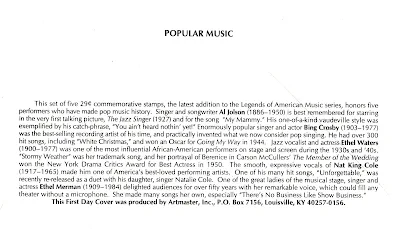
USPS on 1 September 1994 continued with the Legends of American Music series, honoring five popular American singers. The featured performers, each featured separately on 29 cent stamps, were Nat "King" Cole, Ethel Merman, Bing Crosby, Al Jolson and Ethel Waters. Postmark cancellation was in Washington D.C.

Al Jolson
Born Asa Yoelson in Srednike, Lithuania, Al Jolson emigrated with his family to the United States when he was seven. The family settled in Washington D.C., where his father, a rabbi and cantor, hoped his son would follow in his footsteps. But religious music was not for Jolson, who began appearing in burlesque and vaudeville shows at age 13.


His exuberant singing style and personal magnetism made him a favorite with audiences and in 1911 he made his Broadway debut in La Belle Paree. It was during the production of Sinbad in 1918 that he made the Gershwin tune “Swanee” his trademark number. Other Jolson classics include “My Mammy,” “California, Here I Come,” “April Showers,” and “Toot, Toot, Tootsie.”


In 1927, the “king of pop” made film history when he starred in The Jazz Singer. The first feature film with synchronized speech, music, and sound effects, this picture revolutionized the motion picture industry and marked the end of the silent film era. Throughout the 1920s and ’30s Jolson continued to appear in films, and in 1946 the story of his life was filmed in The Jolson Story. A sequel, Jolson Sings Again, was filmed in 1949.
 
Bing Crosby
Born Harry Lillis Crosby in Spokane, Washington, “Bing” Crosby, as he came to be known, got his nickname from a character in the Bingville Bugle, a comic in the Sunday paper. Beginning his career as a jazz singer, he went on to become the most popular entertainer of his day.


Called “the greatest entertainer of the 20th century,” Crosby made more non-rock recordings and placed more songs in the “Top Ten” than any other individual singer. His career as an entertainer spanned more than 50 years, during which time he recorded over 1,600 songs and sold more than 500 million records. His recording of “White Christmas” remains the biggest selling record in history and has become, since it was first recorded, a symbol of Christmas. 


Crosby’s charms extended from stage to screen, and in 1927 he appeared in the film King of Jazz. He went on to make more than 70 films – mostly musicals and romantic comedies. In 1940, he co-starred with Bob Hope and Dorothy Lamour in the highly successful Road to Singapore. Five other “Road” films followed to: Zanzibar, Morocco, Utopia, Rio, and Bali. In 1944, Crosby won an Academy Award for his portrayal of Father O’Malley in the movie Going My Way.
 
Ethel Waters
As a singer, dancer, and actress, Ethel Waters exercised her musical creativity and dramatic expression to gain prominence on the stage and in films. Billed as “Baby Star,” she made her first performance when she was five, in a children’s church program.


At age 17, she began her professional career performing song and dance routines on vaudeville. For her debut she sang W.C. Handy’s classic “St. Louis Blues,” becoming the first woman to sing the song professionally. Billed as “Sweet Mama Stringbean,” she became an overnight success with her low, sweet style of singing the blues.


In 1927, Waters made her Broadway debut in the all-black production Africana, and three years later firmly established her acting career when she starred in Blackbirds. But it was her sensitive performance in Cabin in the Sky (1940) that won her critical acclaim as a dramatic actress. She went on to star in the Hollywood film version of the play, and later appeared in Pinky (1949) and Member of the Wedding (1953).


Called “The Mother of Modern Popular Singing,” Waters spent the last 15 years of her life singing at the Billy Graham Crusades, during which time she made famous the song “His Eye is on the Sparrow.”
 
Nat “King” Cole
Described as “one of the greatest singers of the century,” Nat “King” Cole is best remembered for his satiny-smooth voice, although he originally began his career as a jazz pianist. In fact, his style of using the piano as a solo, rather than a rhythm instrument inspired other pianists to form similar groups and is an influence still felt in the jazz world today.


 The organist at his father’s church, he began playing at jazz clubs and later formed the popular King Cole Trio – one of the first black groups to have their own radio show. In 1943, his recording of “Straighten up and Fly Right” won him fame as a singer, and although he would continue to perform as a jazz musician, his image as a singer would dominate the rest of his career. By the early 1950s, Cole’s music turned to pop with “Walking My Baby Back Home,” “It’s Only a Paper Moon,” and “For Sentimental Reasons.”


Riding on the success of what is considered his best remembered hit “When I Fall in Love,” Cole broke color barriers and made musical history when he was given his own musical TV series. Popular for more than two decades, other successes such as “Mona Lisa” and “Unforgettable,” helped him attain lasting acceptance by audiences throughout the world.
 
Ethel Merman
Born in Astoria, New York, Ethel Zimmermann eventually dropped the “Zim” and the final “n” from her name, to become Ethel Merman. A self-taught singer who was described as “a doll from Astoria with a trumpet in her throat,” she worked as a secretary and part-time performer until she received her big break into show business.


In 1930, her performance in George Gershwin’s musical Girl Crazy catapulted her overnight from an obscure nightclub singer to a superstar of Broadway.   Known as the “Queen of Broadway,” her dazzling career lasted more than 50 years. With her clear, sharp, vibrant voice and spontaneous presentations, she was a favored performer for many of the major songwriters of the day, including Irving Berlin, Cole Porter, and Rodgers and Hammerstein.


In 1934 she made her movie debut. However, she continued to dominate the spotlights of Broadway where she achieved her most notable success in Anything Goes (1934), Red, Hot, and Blue (1936), Annie Get Your Gun (1946), Call Me Madam (1950), and Gypsy (1959). In 1972, Merman was awarded a special Tony Award in recognition of her lifetime contribution to show business.


Source: Mystic Stamps